
Curtains that
fit your windows
& your home.
Off-the-shelf curtains are made for generic windows. Yours aren't generic. We measure every window ourselves, make your curtains to order, and fit them — so they hang properly from the first day.
The fabric makes the curtain
Weight, texture, and composition affect how a curtain falls, how it insulates, and how it looks over time. Here are the main fabric types we work with.
Light, breathable, and beautifully textured. Linen hangs well in pencil pleat and wave headings.
Heavy, insulating, and beautifully light-absorbing — velvet curtains darken a room without blackout lining.
Stable, durable, and available in the widest range of printed and plain options. Works with every heading style.
Lustrous, light-catching, and formally elegant. Suits formal headings on tall drops.
Choose the heading that suits your room
The heading is what makes a curtain look the way it does when it hangs. Not sure which is right for you? Bring samples on the home visit and we'll show you exactly how each one hangs.

Tight, uniform gathers across the full width of the curtain. The traditional heading — works with almost any fabric.
Metal rings punched directly into the fabric, threaded straight onto the pole. Clean, relaxed, and easy to draw.
Continuous S-shaped folds that hang in a uniform, sculptural wave. Requires a specialist track but produces a clean look.
Groups of fabric pinched together at regular intervals. Formal and structured — pairs well with heavier fabrics.
Find out moreFabric loops sewn directly to the top of the curtain. A relaxed, informal look — best suited to casual rooms.
Find out moreA cylinder of fabric at the top of each pleat, held open to form a goblet shape. Structured and elegant.
Find out moreHow it works
From home visit to hung — our process
We handle everything. You don't need to source your own fabric, find a separate seamstress, or arrange a fitter.
We come to you, measure every window, and bring fabric samples.
Once you've chosen heading style, fabric, and lining, we give a fixed price.
Your curtains are cut and made to your exact dimensions in our workroom.
We supply and fit tracks or poles, then hang the finished curtains.
Lining options
Lined, interlined, or blackout?
The lining changes how the curtain insulates, how it hangs, and how it controls light. It's one of the most important decisions.
A cotton or cotton-blend lining sewn to the back of the curtain. Protects the face fabric from sun fading, adds some insulation, and gives the curtain enough body.
A layer of soft bump or domette interlining is added between the face fabric and the lining. This dramatically increases the thermal and acoustic performance.
A foam-backed or coated blackout fabric replaces the standard lining, blocking light transmission through the curtain face. Excellent for bedrooms.
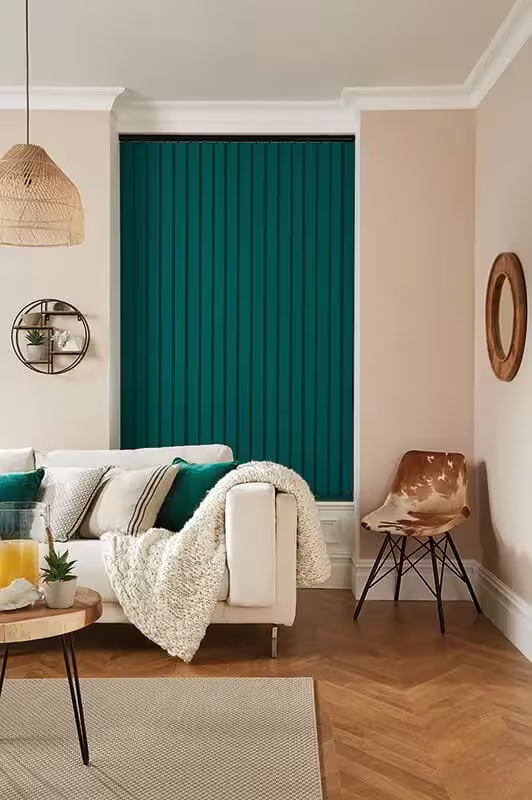
Why made-to-measure curtains
Ready-made curtains are a compromise. Ours aren't.
Ready-made curtains come in three widths and a handful of drop lengths. Your windows almost certainly don't match any of them exactly. Made-to-measure curtains are cut to the precise measurements of your window — the right width, the right drop, the right amount of fabric for the heading style.
- The right width — properly full
Made-to-measure curtains have a fullness ratio built in — typically 2–2.5× the track width — so they gather properly when closed and hang in generous folds when open.
- The exact drop — floor to ceiling
Ready-made drop sizes are fixed and often slightly too short. Made-to-measure curtains are cut to your exact drop — from the track to the floor.
- A fabric you've chosen in person
We bring fabric samples to your home visit so you can see how they look in your room, in your light. Colours and textures read differently on screen.
What our curtain customers say
"We had three rooms done and every set is perfect — the right length, the right fullness, everything. The consultant brought samples to the house and we could see straight away which fabric worked in the room. Would absolutely recommend."
"The interlined curtains in our bedroom have made a genuine difference to how warm the room is — it's an older house and that window was always draughty. Really pleased with the quality of the lining and the way they hang."
"I went for wave heading curtains in the living room and they look exactly as I'd hoped — very clean and contemporary. The fitter was brilliant, patient getting the track level, and the finish is really neat. Very happy."
Curtain questions, answered
Anything else? We'll answer everything at the home visit — no pressure to decide on the day.
How do I choose the right heading style?
Start with the room's character — pencil pleat and pinch pleat suit traditional and period rooms; eyelet and wave suit modern interiors; tab top suits casual, informal rooms. Then consider the fabric: heavier fabrics need structured headings like pencil pleat or goblet; lighter fabrics work well with eyelet or wave. We'll talk through the options at your home visit with samples to look at in your actual room.
Do I need to choose the fabric before the home visit?
No — and we'd actually recommend not deciding until we visit. We bring a wide selection of fabric samples to your home so you can see how they look in your room, in your light. Colours and textures look very different on screen compared to how they read in a real room. The home visit is free and there's no obligation to order.
What's the difference between lined and interlined curtains?
Lined curtains have a cotton backing to protect the face fabric and add some structure. Interlined curtains have an additional layer of soft padding (bump or domette) between the face fabric and lining — this significantly increases thermal and acoustic performance and makes the curtain hang with more weight. Interlined curtains are noticeably warmer and are worth considering for older properties, north-facing rooms, or bay windows.
Can you supply and fit tracks and poles as well as the curtains?
Yes — we supply and fit tracks or poles as part of the same appointment. Tracks are better for wave headings and any application where you want the hardware concealed. Poles suit eyelet, tab top, and informal headings where the hardware is a design feature. We'll advise which suits your chosen heading style at the home visit.
How long does it take from order to fitting?
Typically 4–6 weeks from confirmed order to fitting. This allows time for fabric to be sourced, curtains to be made in our workroom, and a fitting appointment to be scheduled. We'll confirm the expected fitting date before you commit to the order, so you know exactly where you are in the timeline.
Can curtains be made for bay windows?
Yes. Bay windows can be fitted with a continuous curved or angled track that follows the bay, with one set of curtains that draws across the full opening. Alternatively, separate panels can be fitted to each facet of the bay. We'll measure the bay at the home visit and recommend the approach that suits the heading style and the size of the opening.
How much do made-to-measure curtains cost?
Curtain pricing depends on the width and drop of the window, the heading style, the fabric chosen, and the lining option. Made-to-measure curtains are more expensive than ready-made, but they hang correctly, last longer, and suit the room properly — things a ready-made curtain can't reliably deliver. We give a fixed written price at the home visit with no obligation to proceed.
Ready for curtains that actually fit your windows?
Book a free home visit and we'll come to you with fabric samples, measure every window, and leave you with a fixed written price. No obligation — and no pressure to decide on the day.
Free home visit · Fabric samples brought to you · Fixed price · No obligation